

On November 13, Apple will finally start shipping its long-awaited HomeView smart home hub. While the leaks gave us an early look at some of its specs, the official launch exposed its underlying philosophy through distinct hardware and software choices. Although the HomeView is unmistakably designed for iPhone users, its unique direction ushers in an all-new product type built for a future when Apple’s iconic handset doesn’t exist.
The iPhone is by far Apple’s most influential product, and it will likely remain so for a very long time. Because of that legacy, every major Apple device released since its debut has felt like an iteration of the iPhone in one way or another—tweaked to accommodate a specific purpose. For example, many users continue to perceive the iPad as a large-canvas iPhone, while the Apple Watch essentially doubles as a mini iPhone strapped to your wrist. The Vision Pro similarly follows this direction, sharing familiar UIs, the App Store, and common Apple feature sets, acting as an advanced spatial iDevice of sorts. Even the MacBook now has a Dynamic Island.
We’ve reached a point where most of us are surrounded by screens all day long. Whether we’re working during daylight hours or winding down in the evening, chances are we’re facing some kind of rectangular display. Many of us now live in digital bubbles, privately consuming online content and increasingly detaching from our real-life surroundings. Apple’s HomeView doesn’t contribute to the rampant isolation; it discourages it and breaks the longstanding cycle.

Apple’s HomeView ad was an exaggerated view of a family’s frenetic morning routine—but no one was using an iPhone.
Apple
If you’ve seen Apple’s frenetic ad, you noticed that the featured family was using the HomeView in tandem. The home hub harmoniously switched between different user profiles and executed all kinds of tasks in an open, social manner. They could all tell what each member was generally up to based on their voice commands, but private details like iMessages remained solely visible to the active user.
Unlike the Apple TV 4K, the HomeView isn’t designed for long usage sessions. While it supports video streaming, it’s the first Apple product to offer an awkward 7-inch square screen, making it impractical for media consumption and other immersive experiences. It’s meant to keep you present in the moment with other household members around you.
The HomeView expectedly borrows app icons and other features from the iPhone, iPad, and Apple Watch, but it doesn’t behave like any traditional Apple device.
The original iPhone did not offer an App Store and instead limited its users to the core apps included at launch. Likewise, it took the Apple Watch years to support untethered apps and provide a dedicated App Store on watchOS. That, however, does not mean that the HomeView will ultimately follow suit and introduce an App Store. After all, the smart home hub has reportedly been ready for around two years and was only held back due to Siri AI’s delayed release. Apple had plenty of time to port its digital storefront’s foundation to the new platform, but it made a conscious decision to maintain the virtual shackles.
Opening the floodgates would bridge the gap between the HomeView and iPad, which would defeat its whole purpose. Apple doesn’t want the HomeView to become your next TikTok doom-scroll destination. And barring third-party smart home management apps that encourage users to invest in its HomeKit ecosystem—reinforcing its walled garden further.
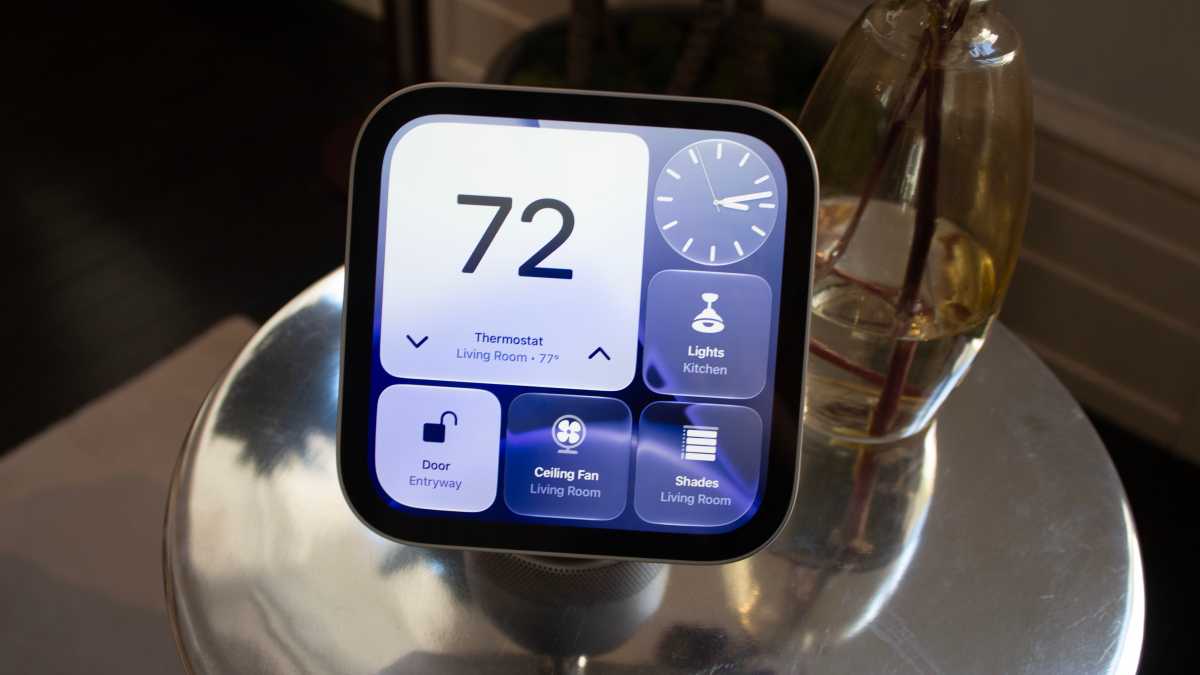
HomeView bridges the screen in your pocket and the people in your house.
Foundry
HomeView’s support for CarPlay extensions and App Intents in compatible iPhone apps via Siri AI suggests that the App Store’s omission is a deliberate move to also push third-party developers to fully adopt App Intents in their software. Otherwise, users likely won’t be able to easily interact with their apps using the smart home hub.
As more developers build for Siri AI and its reliability improves, users will have fewer reasons to pick up their iPhones. They’ll be able to conveniently communicate with others, adjust plans, and make reservations by simply talking to the tiny display in the center of the room. Apple could also potentially minimize the reliance on nearby iPhones by indexing data stored in iCloud, which includes messages, emails, events, reminders, notes, photos, files, and much more. Gemini can already tap into Google Workspace data from any device, and Apple could realistically build a similar infrastructure down the road.
By the time Apple’s rumored smart glasses and other AI gadgets debut, presumably enough developers will have embraced App Intents and Siri AI, all thanks to the HomeView. This will make these fresh concepts—which will primarily operate with Siri’s assistance—fully functional and practical from day one, increasing their popularity and appeal among consumers. Despite beating with an iPhone’s A18 heart, the HomeView is secretly architecting a world where the iPhone stays in our pocket—or perhaps doesn’t exist at all.


